1964½–1966

Since it was introduced four months before the usual start of the 1965 production year and manufactured alongside 1964 Ford Falcons and 1964 Mercury Comets, the earliest Mustangs are widely referred to as the "1964½" model by enthusiasts. Nevertheless, all 1964½ cars were given 1965 U.S. standard VINs at the time of production, and—with limited exception to the earliest of promotional materials—were marketed by Ford as 1965 models. The low-end model hardtop used a "U-code" 170 cu in (2.8 L) straight-6 engine shared with the Falcon, as well as a three-speed manual transmission, and retailed for US$2,368 (equivalent to $23,263 in 2023). Standard equipment for the early 1965 Mustangs included black front seat belts, a glove box light, and a padded dashboard. Production began on March 9, 1964. Mustang Serial Number One (5F08F100001 from the pre-production batch) was sold on April 14, 1964, at the George Parsons Ford dealership in St. John's, Newfoundland, Canada. Official introduction followed on April 17 at the 1964 World's Fair. The V8 models were identified with a badge on the front fender that spelled out the engine's cubic inch displacement ("260" or "289") over a wide "V." This emblem was identical to the one on the 1964 Fairlane.
Several changes to the Mustang occurred at the start of the "normal" 1965 model year in August 1964, about four months after its introduction. These cars are known as "late 65's". The engine lineup was changed, with a 200 cu in (3.3 L) "T-code" engine that produced 120 hp (89 kW; 122 PS). Production of the Fairlane's "F-code" 260 cu in (4.3 L) engine ceased when the 1964 model year ended. It was replaced with a new 200 hp (150 kW) "C-code" 289 cu in (4.7 L) engine with a two-barrel carburetor as the base V8. An "A-code" 225 hp (168 kW; 228 PS) four-barrel carbureted version was next in line, followed by the unchanged 289 HiPo "K-code" equipped with a 4-barrel Autolite 4100 carburetor that was rated at 271 hp (202 kW; 275 PS) at 6000 rpm and 312 lb⋅ft (423 N⋅m) at 3400 rpm. The DC electrical generator was replaced by a new AC alternator on all Fords (a way to distinguish 1964 production from the 1965s is to check if the alternator light on the dash reads "GEN" or "ALT").
GT Equipment Group
The Mustang GT version was introduced as the "GT Equipment Package" and included a V8 engine (most often the 225 hp, 168 kW, 228 PS "289"), grille-mounted fog lamps, rocker-panel stripes, and disc brakes. In the interior, the GT option added a different instrument panel that included a speedometer, fuel gauge, coolant temperature gauge, oil pressure gauge, and an amp meter in five round dials, but the gauges were not marked with numbers.A four-barrel carbureted engine was available with any body style. Additionally, reverse lights were an option added to the car from August 1964 production.
The Mustang was initially available in hardtop or convertible body styles, but a fastback model was considered during the car's early design phase. In 1965, the Shelby Mustang was introduced, available only in a newly introduced fastback body version with its swept-back rear glass and distinctive ventilation louvers. In 1965 Ford built 15,079 Mustangs that featured the GT Equipment Group For 1966, Ford built 25,517 GTs. According to Jim Smart production guide, the fastback would have been the most common, followed by the coupe and then the convertible.
Options

The standard interior was available in various colors and features included adjustable driver and passenger bucket seats, an AM radio, and a floor-mounted shifter. Ford added additional interior options during the 1965 model year. The Interior Decor Group was popularly known as "Pony Interior" due to the addition of embossed running ponies on the seat fronts and included integral armrests, woodgrain appliqué accents, and a round gauge cluster that would replace the standard Falcon instrumentation. Options included sun visors, a (mechanical) remote-operated mirror, a floor console, and a bench seat. Ford later offered an under-dash air-conditioning unit and discontinued the vinyl with cloth insert seat upholstery that was available only in early 1965 models. The Rally-Pac was introduced in 1963 after Ford's success at that year's Monte Carlo Rally. Available on other Ford and Mercury compacts and intermediates, the Rally-Pac consisted of steering column mounted combination clock and tachometer It was available as a factory-ordered option for $69.30. Installed by a dealer, the Rally-Pac was priced at $75.95. A 14-inch wheel option was available for Rally-Pac and GT350R vehicles widening front and rear track to 57.5 inches. A compass, rear seat belts, A/C, and backup lights were also optional.
A nationwide survey of owners by Popular Mechanics included many complaints about legroom. Fuel economy for the base V8 was good for the period, with a test by Popular Mechanics rating the optional 260 cubic inch engine with automatic transmission achieving 20.93 mpg‑US (11.24 L/100 km; 25.14 mpg‑imp) at a steady 60 mph (97 km/h). When equipped with the 289 "HiPo" engine and a 4.11 rear axle ratio, the 1965 Mustang achieved 0–60 mph (0–97 km/h) in 5.2 seconds and a 1⁄4 mile (402 m) time of 14.0 seconds at 100 mph (161 km/h).
The 1966 Mustang debuted with moderate trim changes including a new grille, side ornamentation, wheel covers, and gas cap. Ford's new C4 "Cruise-O-Matic" three-speed automatic transmission became available for the 225 hp V8. The 289 "HiPo" K-code engine was also offered with a C4 transmission, but it had stronger internals and can be identified by the servo's outer casing, which is marked with a 'C'. The long-duration solid-lifter camshaft that allowed the high-revving 289's horsepower rating, was not a good match for a low stall speed automatic torque converter. The "HiPo" could be identified by the 1-inch-thick (25 mm) vibration damper, (compared to 1/2 inch on the 225-hp version) and the absence of a vacuum advance unit on the dual point distributor. With the valve covers removed, a large letter "K" stamped is visible between the valve springs, along with screw-in studs (vs. a pressed-in stud for other 289s) for the adjustable rocker arms. Many new paint and interior color options were available, as well as an AM/eight-track sound system, and one of the first AM/FM mono automobile radios. The 1966 model year cars discontinued the Falcon instrument cluster, while the previously optional round gauges and padded sun visors became standard equipment. The Mustang would become the best-selling convertible in 1966, with 72,119 sold, beating the number two Impala by almost 2:1.
The 1965 and 1966 Mustangs are differentiated by variations in the exterior, despite the similar design. These variations include the cove molding on the rear quarter panels behind the doors. From August 1964 production, the molding was a single vertical piece of chrome, while for 1966 models, the molding was smaller in height and had three horizontal bars extending forward from the design, resembling an "E". The front intake grilles and ornaments were also different. The 1965 front grille used a "honeycomb" pattern, while the 1966 version was a "slotted" style. While both model years used the "Horse and Corral" emblem on the grille, the 1965's had four bars extending from each side of the corral, while these bars were removed for the 1966s. During the 1966 model year, a 'High Country Special' limited edition was available with 333 units sold in Colorado, Wyoming, and Nebraska.
When Ford wanted to introduce the Mustang in Germany, they discovered that the Krupp company had already registered the name for a truck. The German company offered to sell the rights for US$10,000. Ford refused and removed Mustang badges from exported units, instead, they named the cars T-5 (a pre-production Mustang project name) for the German market until 1979, when Krupp copyrights expired.
1965 Mustang AWD prototype
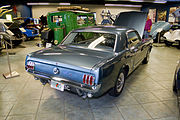
1966 Right-Hand-Drive Mustang
Ford Australia organized the importation and conversion of 1966 model year Mustangs to right-hand-drive (RHD) for the Australian market. This coincided with the launch of the new XR Falcon for 1966, which was marketed as the "Mustang-bred Falcon". The RHD Mustangs were called the "Ford Australia Delivered Mustang", and had compliance plates similar to the XR Falcon, to set the official conversion apart from the cottage industry versions. About 209 were imported by Ford Australia – 48 units were imported and converted in 1965 and a further 161 were prepared in 1966.

.jpg)


.jpg)


great topic..
ReplyDeleteGreat 😃
ReplyDeletegreat
ReplyDeleteCreative
ReplyDelete👍👍
ReplyDelete