Cars Generation
R211 (New York City Subway car)
The R211 is a class of New Technology Train (NTT) subway cars built for the New York City Transit Authority. Being built by Kawasaki Railcar Manufacturing for the B Division of the New York City Subway and for the Staten Island Railway (SIR), they will replace two aging subway car models: all R44 cars on the SIR, plus all R46 and some R68 subway cars. The order is split into three parts: R211A and R211T cars for the subway and R211S cars for the SIR. The R211Ts employ open gangways between cars, allowing passengers to see and walk through the entire length of the train – a feature not present on the subway's other rolling stock.
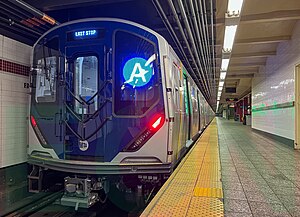
Planning for the R211 order started in 2011. The design process started in 2012, at which time the order was supposed to consist of 75-foot-long (23 m) cars. The cars' lengths were changed to 60 feet (18 m) by 2015, and the first request for proposal was solicited in July 2016. After several changes to the proposal, the Metropolitan Transportation Authority (MTA) awarded a contract to Kawasaki in January 2018. The first photos of the R211 shows an incomplete trailing car in Kawasaki's Kobe factory, the image was likely taken around late 2018. Delivery of the pilot cars began at the end of June 2021. They contain new features such as wider doors, information displays, LED-lit doorways, open gangways, and LED interior lighting. The R211As entered service on March 10, 2023, beginning a 30-day acceptance test on the A. Following a successful second revenue service test with the pilot set, it officially entered service with the first production set on June 29, 2023. The R211T test trains entered service on February 1, 2024, on the C, while the first R211S train entered service on October 8, 2024.

Ford Mustang (first generation)
The first-generation Ford Mustang was manufactured by Ford from March 1964 until 1973. The introduction of the Mustang created a new class of automobiles known as pony cars. The Mustang's styling, with its long hood and short deck, proved wildly popular and inspired a host of competition.

The first-generation Mustangs grew in overall dimensions and engine power with each revision. The 1971 model featured a drastic redesign. After an initial surge, sales steadily declined, and Ford began working on a new generation Mustang. With the onset of the 1973 oil crisis, Ford was prepared, having already designed the smaller Mustang II for the 1974 model year. This new car shared no components with preceding models.
Generation 6 (NASCAR)
The Generation 6 car, shortened to Gen-6, was the common name for the car that was used in the NASCAR Cup Series from 2013 to 2021. The car was part of a project to make NASCAR stock cars look more like their street-legal counterparts. The cars have used many different aero and downforce packages to improve their racing characteristics as well as using the safety measures of its predecessor, the Car of Tomorrow. The Generation 6 car has received both praise and criticism from fans and drivers.
.jpg)
The Generation 6 body style was introduced in the 2013 Daytona 500 and was originally scheduled to be retired after 2020 in favor of the new Next Gen car. However, due to the COVID-19 pandemic, the implementation of the Next Gen car was pushed to 2022.


helpful cars blog ....
ReplyDeleteGreat information
ReplyDelete