Propulsion and fuels
Fossil fuels
Most cars in use in the early 2020s run on petrol burnt in an internal combustion engine (ICE). Some cities ban older more polluting petrol-driven cars and some countries plan to ban sales in future. However, some environmental groups say this phase-out of fossil fuel vehicles must be brought forwards to limit climate change. Production of petrol-fuelled cars peaked in 2017.

Other hydrocarbon fossil fuels also burnt by deflagration (rather than detonation) in ICE cars include diesel, autogas, and CNG. Removal of fossil fuel subsidies, concerns about oil dependence, tightening environmental laws and restrictions on greenhouse gas emissions are propelling work on alternative power systems for cars. This includes hybrid vehicles, plug-in electric vehicles and hydrogen vehicles. Out of all cars sold in 2021, nine per cent were electric, and by the end of that year there were more than 16 million electric cars on the world's roads.Despite rapid growth, less than two per cent of cars on the world's roads were fully electric and plug-in hybrid cars by the end of 2021. Cars for racing or speed records have sometimes employed jet or rocket engines, but these are impractical for common use. Oil consumption has increased rapidly in the 20th and 21st centuries because there are more cars; the 1980s oil glut even fuelled the sales of low-economy vehicles in OECD countries. The BRIC countries are adding to this consumption
.
Batteries
User interface
Cars are equipped with controls used for driving, passenger comfort, and safety, normally operated by a combination of the use of feet and hands, and occasionally by voice on 21st-century cars. These controls include a steering wheel, pedals for operating the brakes and controlling the car's speed (and, in a manual transmission car, a clutch pedal), a shift lever or stick for changing gears, and a number of buttons and dials for turning on lights, ventilation, and other functions. Modern cars' controls are now standardised, such as the location for the accelerator and brake, but this was not always the case. Controls are evolving in response to new technologies, for example, the electric car and the integration of mobile communications.

Electronics and interior
Cars are typically equipped with interior lighting which can be toggled manually or be set to light up automatically with doors open, an entertainment system which originated from car radios, sideways windows which can be lowered or raised electrically (manually on earlier cars), and one or multiple auxiliary power outlets for supplying portable appliances such as mobile phones, portable fridges, power inverters, and electrical air pumps from the on-board electrical system.More costly upper-class and luxury cars are equipped with features earlier such as massage seats and collision avoidance systems.

Lighting
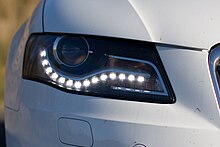
Cars are typically fitted with multiple types of lights. These include headlights, which are used to illuminate the way ahead and make the car visible to other users, so that the vehicle can be used at night; in some jurisdictions, daytime running lights; red brake lights to indicate when the brakes are applied; amber turn signal lights to indicate the turn intentions of the driver; white-coloured reverse lights to illuminate the area behind the car (and indicate that the driver will be or is reversing); and on some vehicles, additional lights (e.g., side marker lights) to increase the visibility of the car. Interior lights on the ceiling of the car are usually fitted for the driver and passengers. Some vehicles also have a boot light and, more rarely,
Weight and size
During the late 20th and early 21st century, cars increased in weight due to batteries,modern steel safety cages, anti-lock brakes, airbags, and "more-powerful—if more efficient—engines" and, as of 2019, typically weigh between 1 and 3 tonnes (1.1 and 3.3 short tons; 0.98 and 2.95 long tons).Heavier cars are safer for the driver from a crash perspective, but more dangerous for other vehicles and road users. The weight of a car influences fuel consumption and performance, with more weight resulting in increased fuel consumption and decreased performance. The Wuling Hongguang Mini EV, a typical city car, weighs about 700 kilograms (1,500 lb). Heavier cars include SUVs and extended-length SUVs like the Suburban. Cars have also become wider.
Some places tax heavier cars more: as well as improving pedestrian safety this can encourage manufacturers to use materials such as recycled aluminium instead of steel. It has been suggested that one benefit of subsidising charging infrastructure is that cars can use lighter batteries.
Seating and body style


helpful blog
ReplyDeleteFantastic 🤍
ReplyDelete