Mini Cooper
Mini Cooper may refer to:
- Performance Cars of the original Mini series with uprated drive train and brakes, called the "Mini Cooper", made by the British Motor Corporation and also the successors 1961–1971, and 1990–2000
- Cars of the Mini (marque), including several different models produced by BMW since 2000 with the "Mini Cooper" title:
- MINI Hatch, introduced in early 2000, second generation from 2006, third generation from 2014, and fourth generation from 2024. changing the model name to MINI Cooper.[1]
- Mini Clubman (2007–2024)
- MINI Countryman
- MINI Coupé and Roadster
- MINI Paceman
MINI Aceman
Mini Hatch
The Mini (stylised as MINI) supermini range, marketed under various names such as Mini Cooper, Mini Hatch, Mini Hardtop, Mini One, and Mini John Cooper Works, are a family of retro-styled three-door hatchback, two-door convertible, and five-door hatchback (since 2014). The range was introduced in July 2001, following the acquisition of the Mini brand by German automaker BMW.
BMW first unveiled the Mini hatch concept car at the 1997 Frankfurt International Motor Show, when the Mini brand was still part of the BMW-owned Rover Group. Developed as a successor to the original Mini, the styling of the concept car was well received by the public and further developed. The new Mini range was launched by BMW in 2001, one year after their sale of the Rover Group in March 2000, and the classic Mini's discontinuation that same year. Under BMW ownership, the brand later grew its line-up by adding larger models such as the Clubman in 2007, the Countryman in 2010, the Paceman in 2012, and the Aceman in 2024.

The second generation was launched in 2006 and the third, adding a longer 4/5-door hatchback, in 2014. A two-door convertible version was added in 2004, followed by its second generation in 2008. With the launch of the fourth generation in 2024, the Mini Hatch has been renamed to Mini Cooper.
BMW also developed several battery electric versions of the Mini, starting with the Mini E in 2009 developed only for field trials, followed by the mass-produced Mini Electric in 2019, and succeeded by the Mini Cooper E/SE in 2023 which uses a dedicated electric vehicle platform.
Mini models under BMW ownership are produced in Cowley, Oxfordshire, United Kingdom at Plant Oxford. Between July 2014 and February 2024, 3-door production was shared with VDL Nedcar in Born, Netherlands. The Mini convertible was only assembled in the Netherlands between 2015 and 2024. From 2024, all next generation combustion engined Mini hatch and convertible production will be centred at Oxford. Since late 2023, the electric Mini Cooper is developed and produced in China at the Spotlight Automotive joint venture facility in Zhangjiagang, Jiangsu.
Mini Countryman
The Mini Countryman, also called Mini Crossover in Japan until 2024, is a subcompact crossover SUV, the first vehicle of this type to be launched by BMW under the Mini marque. It was launched in 2010 and received a facelift in 2014. The second generation vehicle was released in 2017 and received a facelift in 2020. The third generation of the Countryman was released in 2023.

The design of Mini's first five-door crossover echoed that of the Mini Crossover Concept. The production model was first unveiled at the 2010 Geneva Motor Show. UK models went on sale on 18 September 2010.The availability of models varies between markets, with the United States and Russia not taking the One versions or any diesel-powered models. The All4 all-wheel-drive option is available on variable models, again depending on the country.

The ALL4 all-wheel-drive powertrain includes electro-hydraulic differential, positioned
directly on the transmission's final drive, to vary the power distribution from front to rear. Under normal driving conditions, up to 50 percent of the engine's power goes to the rear wheels. Under "extreme" conditions ("extreme" being undefined) up to 100 percent heads to the back wheels.
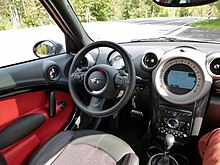
In 2012 the Countryman received some minor amendments, including an EU6 exhaust emissions standard compliance for the One and Cooper models, and using a different clutch material and improved software to reduce stalling problems. They went on sale from November 2012.
A Cooper ALL4 model was added in July 2013.
Changes to US 2014 model year range included the omission of the interior "Centre Rail" feature from the back seats. The rail is still present in the front.
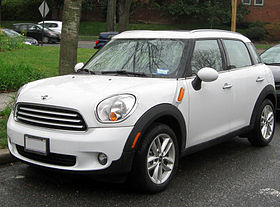
2014 update (R60 LCI)
A minor facelift to the Countryman was unveiled at the 2014 New York International Auto Show Changes include a new structure of the hexagonal radiator grill, underride guard elements for the Cooper S Countryman ALL4 and additional body colour options. It went on sale in July 2014. All variants carried over. US variants include Cooper, Cooper S, Cooper S ALL4, John Cooper Works (with ALL4), with 6-speed manual transmission or optional 6-speed automatic transmission.

_Cooper_hatchback_(2018-09-03)_02.jpg)
The second generation Countryman was introduced at the LA Auto Show in November 2016 and went on sale in February 2017 in Europe, and March elsewhere. It was launched with three variants: Cooper (FWD or ALL4), Cooper S (FWD or ALL4), and in June 2017, the new Cooper S E ALL4 plug-in hybrid. The new Countryman is 203 millimetres (8.0 in) longer than the first generation, and 25-millimetre (0.98 in) wider. The Cooper Countryman is powered by a turbocharged 3-cylinder engine, while the Cooper S uses a 2.0-litre turbo I4.
The Cooper S E plug-in hybrid combines a 134 hp (100 kW) 3-cylinder petrol engine and a 65 kW (88 PS; 87 hp) synchronous electric motor, producing a combined system output of 221 hp (165 kW) with system torque of 385 N·m (284 lb-ft). Average fuel consumption on the NEDC test cycle is 112 mpg‑US (2.10 L/100 km; 135 mpg‑imp), with CO2 emissions of 49 grams per kilometer. The 7.6 kWh lithium-ion battery is positioned directly in front of the electric motor underneath the rear seat, delivering an all-electric range of up to 40 km (25 mi) and a top speed of 126 km/h (78 mph). Charging at a 240-volt socket takes 3 hours and 15 minutes.
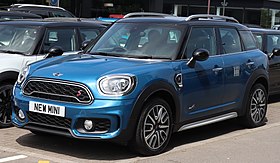
Mini makes the John Cooper Works edition available again in this generation with the tuned version based on the Cooper S. The 2.0-litre four-cylinder petrol engine has been upgraded with a new heat-resistant turbocharger and additional inter-cooler, resulting in 228 bhp (170 kW; 231 PS), 258 lb⋅ft (350 N⋅m) of torque and a 0-62 mph (100 km/h) time of 6.5 seconds. Similar to the Countryman S, JCW Countryman can be mated to either a 6-speed manual or 8-speed automatic transmission (which comes with the option to choose between Normal, Sport, and Eco mode). United States EPA-tested fuel economy for the JCW under manual transmission is 20 mpg‑US (12 L/100 km; 24 mpg‑imp) for city and 29 mpg‑US (8.1 L/100 km; 35 mpg‑imp) for highway which the automatic does slightly better with 22 mpg‑US (11 L/100 km; 26 mpg‑imp) for city and 30 mpg‑US (7.8 L/100 km; 36 mpg‑imp) for highway.
In summer 2019, Mini launched an updated version of the Countryman JCW, unofficially known as Countryman JCW 306. This is thanks to the now increased output of 306 PS (225 kW; 302 hp) which now gives the vehicle a 0-62 mph (100 km/h) time of 5.1 seconds.


Great work 👍
ReplyDeleteinformative knowledgeable blog...
ReplyDeleteGreat work
ReplyDeleteGreat work
ReplyDeleteExcellent 👌
ReplyDeletegood
ReplyDeleteAmazing Effort
ReplyDeleteOutstanding
ReplyDelete👍
ReplyDelete